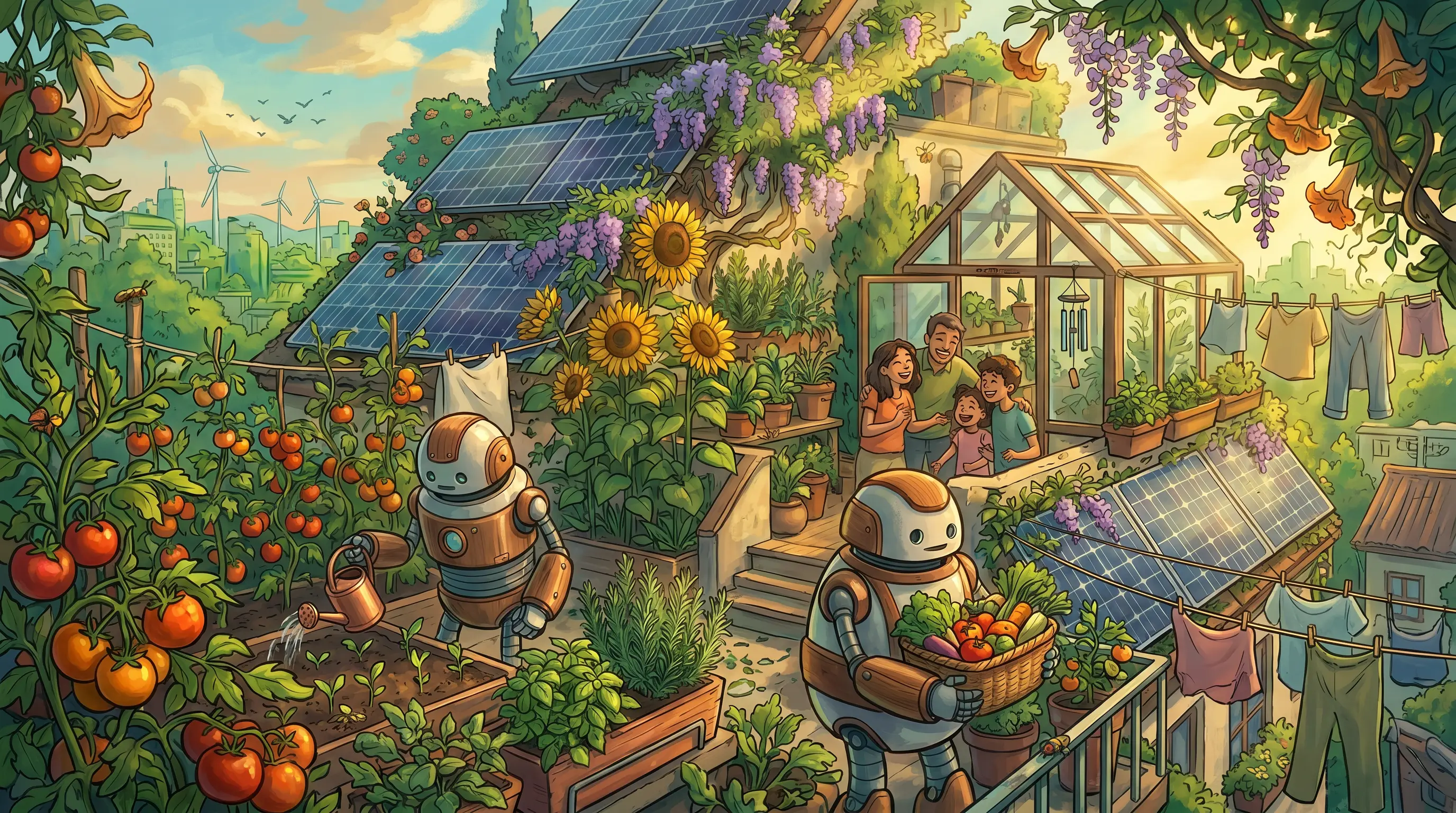
A rooftop garden at golden hour: two rounded copper robots water tomato beds and carry a vegetable basket while a family laughs by the greenhouse, solar panels draped in wisteria overhead.
Field recording nº 07 · rooftop commons · 6:04 am

The garden computes.

Somewhere above a city that forgot to look up, the morning shift clocks in on soft rubber feet. Nobody owns these machines but the neighborhood. A documentary in one painting. Move gently — everything here does.

Exhibit A · Field notes

Three species of helper have settled this rooftop.

They were not sent by a company, and they are not coming for anyone’s job. They are coming for the aphids. Observations below were collected over one growing season, at reading pace.

The Pruner

Rosa custodiens · wheeled, shear-bearing

Spends four hours deciding and one second cutting. It keeps a ledger of every stem since planting day and has never once uploaded it — there is nowhere to upload it to. That’s not a missing feature. That’s the design.

The Porter

Aquarius patiens · bipedal, basket-backed

At 6:04 each morning, the Porter wakes, stretches its hydraulics, and carries water uphill so the tomatoes don’t have to wait for rain. It has done this 2,190 mornings in a row. The tomatoes act like royalty. The Porter doesn’t mind.

The Pollinator

Apis ferrea · winged, pocket-sized

Weighs less than a plum. Visits eleven thousand blossoms a season and charges on a windowsill, in the sun, for free. The real bees supervise from the lavender, unbothered. There is plenty of work to go around.

Exhibit B · The living painting

This is not a rendering of the future. It’s a to-do list.

The same rooftop garden painting, about to move: leaves ready to sway, the watering robot mid-pour. hanging the painting… Alive · six seconds, forever
Morning Shift, on loop — light, water, patience Wind · hydraulics · 4.2 kWh of sunshine

Six seconds of an ordinary morning, repeating. The leaves move because wind is free. The robot waters because someone in the building fixed its elbow last week — on a kitchen table, with published schematics and a Tuesday afternoon.

Every piece of this scene ships today: the panels, the raised beds, the stubborn little machines. The only part still rendering is the decision to build it.

Exhibit C · Why the machines are friendly

“A robot you can’t repair is a pet that owns you.

The machines in this garden are gentle for a boring, wonderful reason: the neighborhood can open them. No sealed cases, no subscriptions, no firmware that files a report. The garden computes — and it doesn’t report to anyone.

The proof hangs by the seed chart, laminated against the watering can: the Porter’s own drawing, coffee ring and all.

i.

Opens with a screwdriver

A normal one. No proprietary heads, no warranty-void stickers — void of stickers entirely. If you can grow a tomato, you can swap a servo.

ii.

Schematics live in the greenhouse

Printed, laminated, taped up next to the seed chart — where documentation belongs. The Porter’s wiring diagram has a coffee ring on it. It still works.

iii.

Parts print at the library

The elbow bushing is a forty-minute print and costs less than the coffee. The librarian has strong opinions about infill. She is usually right.

iv.

Speaks only when spoken to

No telemetry, no analytics, no quiet phone-home at 3 a.m. The only cloud these machines know is the kind that means rain is coming.

Tomorrow · 6:03 am

The future needs gardeners. Some of them will need charging.

Solarpunk isn’t a genre. It’s a maintenance schedule. Start with a planter box, a repair manual, or a machine you actually own — the garden takes volunteers.

Sour Labs — sweet tools, sour to the system. 🍋